

Worth Fighting: An Interview With War On Women
By Staff | December 11, 2025
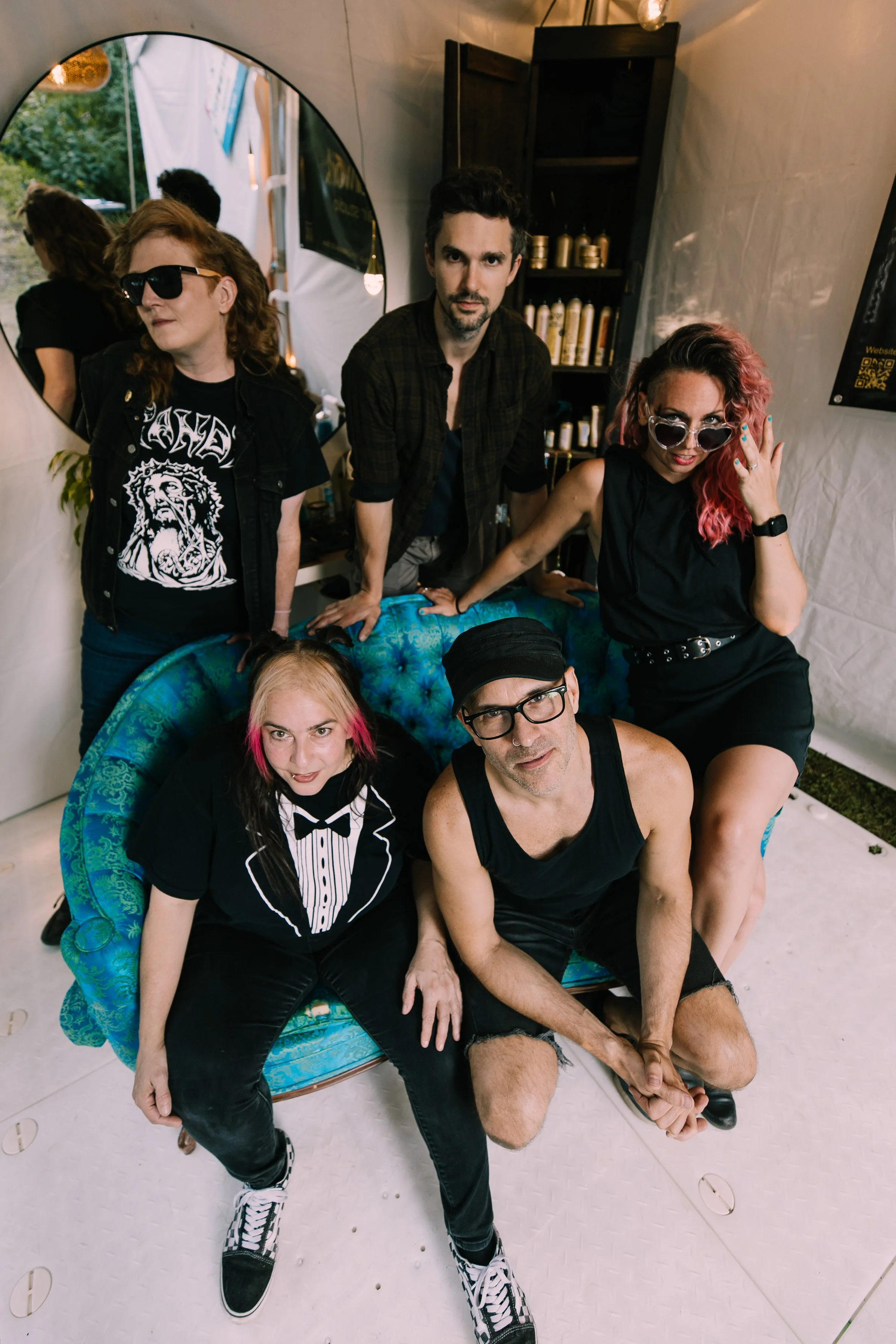
Photo credit: Johnny Riverfest
The Baltimore hardcore band War On Women employs a potent blend of hardcore punk aggression and feminist punk energy, creating music that is both politically charged and a rejection of the status quo. The band, both individually and through their music, is outspoken in fiercely tackling systemic social inequities, the gender pay gap, transphobia, abortion rights, and misogyny. In this interview, vocalist Shawna Potter discusses her use of the music to personally process her outrage at the mistreatment of marginalized communities while fostering awareness and empowerment for listeners. The title of their upcoming album, Time Under Tension, metaphorically captures the current political pressure, suggesting the choice to either break down or emerge stronger from the struggle against global fascism.
How do you balance the aggression of hardcore punk with the emotional and intellectual depth of the political and social issues you address?
Shawna Potter, vocals: Hopefully, well? I feel like I’m just sharing things I’ve learned, or sharing my take, or just what I’m feeling at that moment about something. I don’t look at being serious and fun as mutually exclusive, it’s all part of the human experience, but at no point am I taking anything I write about lightly.
Beyond the raw emotion, how do you approach the craft of songwriting to ensure your powerful messages are also memorable and impactful?
That is not something that can be ensured. We always strive to write the best songs we can, that we can be proud of. I do know the power of an ear worm though, and there’s no reason heavy music can’t be catchy. As the band has gone on, for some albums we’ve had more time for editing and perfecting than others. This latest one we had more time and I think it shows.
War On Women is often compared to the Riot Grrrl movement. Do you embrace that comparison, and what legacy do you see yourselves building on?
To me, Riot Grrrl was a moment in time, not a genre. So I don’t fully think it’s an accurate title for us musically, but in spirit? I would be honored to be a footnote in the history of it. It is my version of punk, a rejection of the status quo, and I would not be the same musician or the same person without it.
Your lyrics cover issues like r*pe culture, the gender pay gap, and transphobia. When writing a song on a sensitive or complicated topic, what is your primary goal for the listener?
I don’t think about it like that. I’m trying to process or release what I’m feeling about something. but I’m a little embarrassed to admit I do hope someone reading the lyrics finds them clever. I enjoy a turn of phrase or double entendre. But I don’t write with a listener in mind. I think I sometimes edit with listeners in mind, but the raw ideas need to get onto paper with no restrictions. Otherwise I’d never get to the good stuff. While I don’t count on it to do what I do, I am grateful when someone listening learns something new, thinks about an issue in a different way, or finds some sort of empowerment from a song.
Can you discuss the meaning behind the title of one of your recent albums, like Wonderful Hell or Capture the Flag?
What about our new album, Time Under Tension? I feel it describes this moment in time, politically. I learned this phrase in relation to building muscle strength, and so I partly visualize it like that - as we move closer into global fascism, something is gonna give and we can either get stronger and more supportive from it, or we can give up because it hurts too much or is too much work. But it’s really about being under that tension, wondering how long we handle the pressure before things explode.
How do you manage the risk of your band name, War On Women, being misinterpreted, and why was it the right name for the project?
We set out to raise awareness that the War on Women as a concept is real and worth fighting. We’ve been a band long enough that at the time, the phrase was still relatively new. My only concern with War On Women as a band name being misinterpreted is a potential false assumption that we don’t support our trans siblings. We absolutely do. It’s been a big part of my activism from the start, when I was doing more organizing and on the ground work, and our song “Second Wave Goodbye,” which is about trans rights, is super important to me. Unfortunately, all oppression is connected so there is no lack of things for me to write about.
Shawna, you recently wrote the book Making Spaces Safer. What is the most crucial step a music venue or band can take immediately to make their space safer?
What I see most people do is put up signs; signs about what behavior is encouraged or discouraged in a venue, and who to tell if harassment happens. And that is great and helpful! But anyone can put up a sign, it’s about knowing how to follow through in a victim-centered way once you get a complaint. So I’d say making sure the staff knows basic active listening skills and giving victims a choice in how to handle complaints. I go over all of this in detail in my book, of course, and in January of 2026 I will be publishing a self-guided online course version of my program on my website www.shawnapotter.com if anyone wants to learn more.
War on Women frequently brings up the need for bystander intervention. What advice would you give to a fan who witnesses harassment at a show?
Use whichever of the 5 Ds works for you, just don’t do nothing!
The band has been vocal about intersectionality. How do you ensure your feminist message is inclusive and addresses the experiences of women and marginalized people of color and in the LGBTQ+ community?
Personally, I’m just always learning and staying active so that I have good cultural competency. I think it’s important to not speak for others, to not pretend that I’m anything other than a privileged, white, cis-, able-bodied woman. But I think it’s valuable to share my outrage at the way other communities are treated. Selfishly, because it’s an emotion that I feel that I need to process, but also because it might raise some awareness or fire people up in some way to do something about it.
Do you view your music primarily as a form of protest, a tool for education, or a source of empowerment?
It can be very difficult to talk about an artistic endeavor so logically. Sometimes it feels weird to question the magic part of it. But I think of us as a political band, which provides a bit more freedom for me to get satirical or add humor, or despair, even. If others find our music helpful for protesting, education, or empowerment, then I am very humbled and grateful for that.
In a world where news cycles move so quickly, how do you decide which contemporary political and social issues to focus on in your music?
There’s the magic part. Whatever sticks with me. I don’t question it and I don’t try to force a song about any particular topic if I can’t find my “way in.”
What is the biggest misconception you feel people have about what it means to be an "activist band" in the hardcore scene today?
I consider an activist band to be one that writes about political issues and also does some activism behind the scenes, but they don’t have to be organizers or the face of a movement. It can be quiet and personal. And storytelling is a valuable role creating social change. One of many. I’ve recommended https://www.socialchangemap.com/ to lots of people to help them figure out their role, and hopefully shed some unnecessary guilt over the idea that you have to do everything to do something.
How has the experience of touring, particularly on large festivals, influenced your perspective on the accessibility and inclusivity of the music industry?
Yeah, it’s just confirmed that the world is not built with every body in mind. There’s still a lot of self-advocacy needed, which can be a big burden for marginalized people. I talk about this in my book and online course, but those in charge of events or venues should really be taking initiative to ensure people know they are welcome before they show up. The UK organization Attitude is Everything has some great advice on this!
For young women and marginalized people starting out in the punk/hardcore scene, what is the most important piece of advice you can offer?
Stop caring what other people think! That doesn't mean don’t care about other people, it means don’t let their bullshit stop you from being in a band or dressing how you want. But here’s the tough caveat: just because it comes from a man or someone older, doesn’t mean a bit of advice isn’t good. It’s very easy to disregard anything that more privileged people say as patronizing, but if you don’t develop a good filter for discernment, you’re gonna miss out on some good ideas. Frustrating, I know!
As a band with a clear political focus, how do you handle online criticism or backlash, particularly from people who fundamentally disagree with your message?
It’s way easier to disregard people that don’t believe in equality or that, I don’t know, oppression is bad. Who cares? They clearly don’t listen to the band and they’re just commenting on a post because the algorithm led them there. For those that ultimately agree with where we’re going, I try to find the good and necessary bits of what they’re saying, take and use what is helpful and true, and try to let go of the rest. It’s difficult, to be sure. Thank goodness for therapy! But already knowing you’ll never get it right 100% of the time and just striving to do your best helps reduce the frustration around making a mistake when it inevitably happens.
Looking ahead, what is the ultimate goal for War On Women—musically, politically, or otherwise?
For me, it’s to make good music and play cool shows and stay healthy and content while doing so.
Links
Wikipedia: https://en.wikipedia.org/wiki/War_on_Women_(band)
Shawna’s website: https://shawnapotter.com/
Merch: https://waronwomen.bigcartel.com/
Bandcamp: https://waronwomen.bandcamp.com/music
Press release: http://www.atomsplitterpr.com/
Media: http://www.atomsplitterpr.com/
Booking: margie@doitbooking.com