

Ethics Matter: An Interview With Allison Moyer of She Zine Mag
By Staff | December 12, 2025
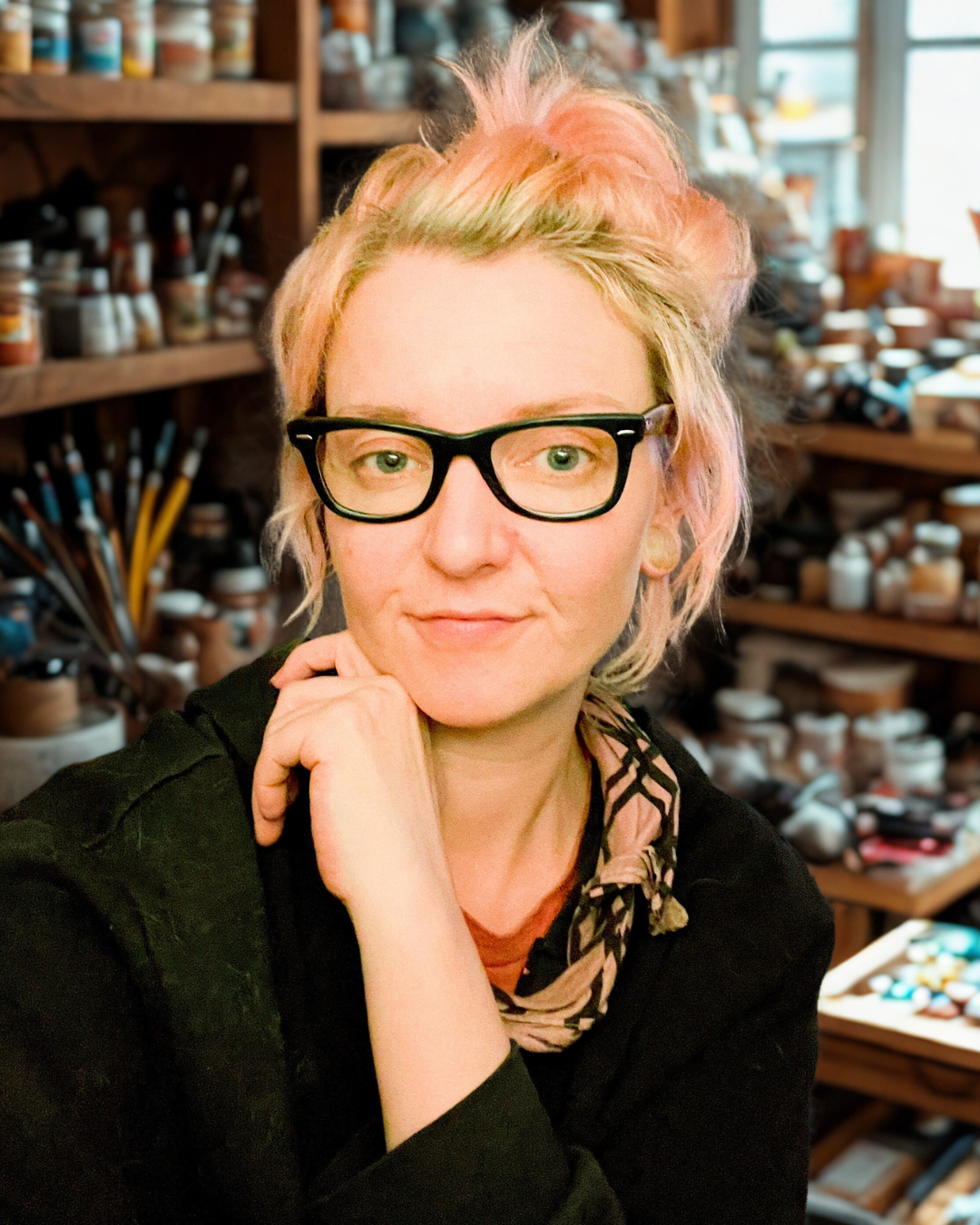
She Zine Mag is not, strictly speaking, a punk magazine. But it may be more punk than anything we’ve come across in quite a while.
Their operations are deeply informed by some pretty hardcore principles —speaking truth to power, fostering inclusiveness, and doing it yourself. The zine's approach is to not sit there and be quiet when hierarchical power structures exploit women, queer folks, racialized creators, or workers. They are is dedicated to speaking the truth no matter the cost, amplifying not the faces of movements, but those who are doing the real work, and calling bullshit when there is bullshit to be called out. And they are not afraid to do so.
We had a chance to sit down with editor Allison Moyer for a wide-ranging interview, and we absolutely loved what she had to say. We think you will too.
Welcome Allison! This may be the first interview you’ve done with a punk interview website. Punk culture is strongly rooted in an ethos that hews strongly to the principles of DIY, outspokenness and challenging authority. How do you, personally and professionally, resonate with these principles?
Allison Moyer, She Zine Mag: This is my first interview with a punk interview site, and I’m genuinely thrilled about it, because She Zine has always been punk at its core — not in the aesthetic sense, but in the “make it yourself, speak up, break the machine” way.
Personally, I’ve always resonated with DIY because it’s the only way I ever learned how to move through the world. I grew up without access, without institutional backing, without anyone opening doors for me. If something needed doing, I had to teach myself how to do it — publishing, printing, coding, art direction, all of it. That skill set came from necessity, but it also shaped my values. I think that punk and the riot grrrl movement gave me the language to instincts I already had.
Professionally, outspokenness and challenging authority show up in how I run the zine: I don’t want She Zine to play nice with power structures that exploit women, queer folks, racialized creators, or workers. We’re here to tell the truth, amplify the people doing the real work, and call bullshit when something is harmful. Even if it’s uncomfortable or inconvenient.
She Zine is built on punk-informed publishing ethics. What key elements of traditional zine culture do you feel are most vital to translate into the current digital media landscape?
For me, the most vital parts of traditional zine culture aren’t the photocopiers and glue sticks — it’s the ethics. Zines were never just “cool little booklets.” They were systems of trust, care, resistance, and resourcefulness. Translating that into digital media is the real work.
The first thing that matters is voice. Zines were unapologetically personal — you knew exactly who was speaking and why. Nothing was written by committee. Online media tends to flatten everything into generic SEO-friendly content, so staying rooted in a human, opinionated voice feels like an act of preservation.
The second is accessibility, in the broadest sense. Zines didn’t assume expertise, pedigree, or insider knowledge. Anyone could make one, anyone could contribute, anyone could start a conversation. In the digital version of that, it means making the site readable, transparent, and genuinely welcoming to people who don’t see themselves reflected in mainstream feminist media.
The third piece is anti-perfectionism as a political stance. Zines were rough because the world was rough — not because people lacked skill. The scrappiness was honest. In a digital environment obsessed with polish and branding, intentionally leaving space for imperfection, humour, and experimentation keeps us anchored to that lineage.
Zines circulated through hand-to-hand networks, word of mouth, and shared curiosity. Nothing about that model translates directly to the internet, but the value underneath it does. So the short answer is: we’re taking the heart of zine culture — the intimacy, the politics, the DIY ethics — and applying it to a space that tends to prioritise speed, aesthetics, and scale. It’s not always tidy, but that’s exactly why it feels right.
She Zine's audience spans zine nerds, riot grrrls who never grew out of it, and anxious zoomers. How do you cultivate a single editorial voice that speaks authentically to such a diverse range of generations and subcultures?
I love this question, and I’m really glad you noticed how intentional we are about speaking to a wide range of readers. When I was a teenager, I always gravitated toward media meant for people a little older than me. I hung out with older kids, I wanted to know what they were listening to and reading, and I loved the feeling of being invited into a world that wasn’t exactly mine yet.
That energy is baked into She Zine. We’re building a space where younger readers can “hang out with the older kids,” and where Gen X and elder millennials can tap into what the next wave is doing without feeling like tourists. It’s less about flattening everyone into one voice and more about creating a tone that feels welcoming, smart, and a little mischievous. Something that resonates across generations because it respects the intelligence and lived experience of all of them.
I still follow a lot of blogs from the early 2010s, and one thing I’ve noticed is that many of them never really evolved with their audiences. They’re frozen in time. With She Zine, I wanted the opposite: space to grow, adapt, and age alongside the people who read us. Our editorial voice is built to flex. It can be sharp, nostalgic, political, or playful depending on the story — but the core stays the same: grounded, feminist, DIY-minded, and anti-pretentious.

She Zine encourages readers to call you out as often as they can. Can you share an example of a time the magazine was called out, and if that feedback led to a change in policy or content?
Very early on, I wanted to write a piece about the National Day of Awareness for Missing and Murdered Indigenous Women and Girls, recognized on May 5th in Canada. I did a ton of research and drafted the foundation of the article, and to finish it, I hoped to speak with Indigenous mothers whose families or communities had been directly affected.
I eventually connected with a mother in British Columbia whose daughter went missing along the Highway of Tears in 2017. She agreed to talk with me, but during those early back-and-forths, other members of her community started reaching out to me on social media.
Honestly? They wanted to know who the fuck I was and what I thought I was doing. She Zine had only a handful of posts at that point; I had no established reputation, no proof of trustworthiness, nothing to reassure people that I wouldn’t mishandle their stories.
No one explicitly told me not to write the piece, but through those conversations, it became clear that I wasn’t the right person to tell the story in the way I had written it. I was approaching the topic from a place of shared grief — but the grief wasn’t mine. The draft read like I was trying to claim proximity to an experience that isn’t mine to inhabit.
It was a mistake, and I’m grateful I had the chance to listen before I published anything. Their concerns taught me a lesson I needed to learn early: intention isn’t enough. If I had published that piece as-is, I would absolutely look back on it with embarrassment and shame.
Calling us out, or even just questioning us, helped reshape our editorial ethics before they ever solidified into policy. That moment still guides how I approach stories that aren’t mine to tell.
Was there a foundational piece of media—a specific zine, book, or movement— that served as the primary inspiration or spark for the current iteration of She Zine Mag 2.0?
Absolutely. Sitting on the Gen X/Millennial cusp meant I got to watch the whole evolution of feminist media happen in real time. I saw publications like Venus Zine and Bust make the jump from scrappy DIY zines to full-blown magazines, and I was obsessed with every stage of it. So many feminist staples — Jane, Bitch, and unfortunately Venus — are gone now, but Bust is still holding on, although they scaled back to a quarterly format several years ago. I still have my subscription, and I pick up back issues on eBay whenever I can find them.
The late 2000s to early 2010s was easily the most exciting time on the internet for me, when everyone had a blog and community felt wide open. This was right before MySpace took over and everyone migrated their little corners of the web to a profile page. All of a sudden, a 20-something in Winnipeg, Manitoba could plug into the global DIY movement, connect with groups like the Austin Craft Mafia or the Church of Craft, and buy from independent makers around the world through sites like CutxPaste and Etsy (back when Etsy was 100% handmade). It felt like a renaissance: feminist creativity, punk ethics, small-scale commerce, and community all happening at once.
She Zine describes itself as being anti-capitalist in values and practice (and we do too!). How do you reconcile this core belief with the necessity of generating revenue through methods like branded collaborations and the online store?
That’s a hard one, and I think we’re still figuring it out. The truth is, it would be incredibly easy to just open an Amazon affiliate account and start dropping links into every post. They carry everything, the commission structure is straightforward, and a lot of small vendors we genuinely want to support are on the platform. From a purely logistical perspective, it would simplify a lot.
But if we claim to be anti-capitalist in our values, then we can’t build our revenue model around the most extractive company on the planet. So instead, we make slower, less profitable choices. We vet every affiliate partnership. We prioritize small, indie-owned, female-led, Canadian, ethical, vegan, or environmentally conscious companies — not because it’s the most lucrative route, but because it aligns with what we want to model as a feminist publication.
Making money isn’t inherently unethical. Surviving is not unethical. Paying contributors and covering overhead is not unethical. What matters is how that money is generated and who it ultimately supports. So the reconciliation, for us, is about transparency and intention: building revenue streams that don’t compromise the politics we claim to care about, even if that means growing slower than we could.
It’s imperfect, it’s evolving, and sometimes it’s inconvenient, but that’s the cost of trying to do this differently.
What non-negotiable ethical red lines (beyond Amazon links and shady fast-fashion) must a company meet to be considered for an affiliate partnership or branded collaboration with Shezine?
It’s really not that complicated. If something makes us cringe, it’s probably not a good fit. That doesn’t mean we’ll work with absolutely anyone, but our baseline is pretty intuitive: does this partnership feel aligned with who we are, or does it feel off?
We’ll always gravitate toward small businesses, especially ones that are female-led or Canadian, though those aren’t hard requirements (there’s a ton of American small businesses we love). What matters most is that the company’s values match ours —environmentally conscious, vegan when applicable, ethical production, all of that. If a brand is cutting corners or building its success on harm, exploitation, or greenwashing, then it’s an automatic no. It’s less about perfection and more about intent and integrity.
If you would, describe a story, situation or proposal, if any, that may have come across your desk that made you say "umm, no. Fuck no."
We’ve had a few proposals over the years that made us immediately cringe. The most memorable was a fast-fashion brand pitching a ‘feminist collab’ — empowerment slogans printed on T-shirts made under conditions that were anything but empowering. The budget was generous, but the values were nonexistent. For us, anything that exploits workers, greenwashes harm, or tries to use feminist language as a marketing veneer is an automatic ‘umm, no. Fuck no.’ We’d rather stay small and principled than grow through partnerships that undermine what we’re building.
The magazine centers Canadian content while basing its work on the traditional territory of Tkaronto. How do you ensure that your focus on anti-racism and decolonization is consistently and ethically reflected in your editorial choices?
In 2018 She Zine had a really great community of contributors from different racial backgrounds who helped us reach a broader audience and informed the way we approached stories that didn’t come from our lived experience. Their perspectives shaped our editorial decisions, our blind spots, and our understanding of what responsible storytelling looks like.
As we return to the project now, the same principle stands: we don’t speak over people, and we don’t fill in stories that aren’t ours to tell. When we cover topics that intersect with race, culture, or identity, our aim is to spotlight the writers, artists, and communities who carry that knowledge firsthand. Our job is to make space, compensate fairly, and support their work — not to position ourselves as authorities on experiences we haven’t lived.
We’re only a couple months post-launch at this point and it’s going to take time to recruit the contributors we need to realize our editorial goals but we understand that these things take time. We’ve been through the process before and if you create the space it’s been our experience that the storytellers will come.
You combine political action (Fight) with personal creativity (Make) and community (Lifestyle). Why was it important to structure the magazine to integrate these seemingly separate aspects of feminist life?
For me, it comes down to balance. Both for the readers and for myself. Fighting systems, making things, and building community aren’t actually separate parts of feminist life; they’re just different expressions of the same impulse to shape the world into something more liveable.
But I didn’t want She Zine to feel heavy all the time. Political analysis is important, but so is joy, craft, daily ritual, and the softness we carve out for ourselves. Blending Fight, Make, and Lifestyle keeps the magazine emotionally sustainable. I can write it without burning out (which sealed the fate of the mag back in 2018), and readers can engage without feeling crushed by the state of the world.
It also lets us reach a wider generational audience. Some people come for the politics, some for the creativity, some for the community-building — and once they’re here, they often wander into the other sections naturally. That cross-pollination is the whole point: feminist life isn’t siloed, so the magazine shouldn’t be either.
The editorial process mentions using an "internal vibe check." How do you define and standardize the criteria for this "vibe check" to ensure it remains inclusive and avoids gatekeeping?
The “internal vibe check” started as a joke shorthand. That’s not really language that I would typically use. It’s just basically a way of naming that gut feeling you get when something is technically fine but off. Over time we realized it was actually one of our most reliable editorial tools, as long as we defined it clearly and used it ethically.
To avoid turning it into some exclusive, opaque standard, we wrote down what the vibe check actually means: no appropriation, no punching down, no cruelty, no lazy feminism, no flattening of lived experience, no extractive storytelling, no content that treats marginalized identities as aesthetics. And on the flip side: community-first, maker-first, anti-capitalist, curious, weird, tender, angry when necessary, and always open to correction.
We treat it as a collective checkpoint. Contributors can ask for clarity. And if we can’t explain why something doesn’t pass the vibe check, then it’s not a vibe check — it’s bias, and we fix that.
You aim to be "slow and intentional" rather than operate like a corporate machine. In practical terms, what does "slow" mean for your day-to-day operations and publication frequency?
The original She Zine broke me in a lot of ways. Back then I was trying to post three times a day, five days a week, and we launched in 2016 — a year when the political atmosphere was super anxiety inducing. There was so much happening that we couldn’t ignore, and I felt responsible for keeping up with all of it, all the time. It wasn’t sustainable, and even though we had contributors at the time, it still pushed the project into a pace that didn’t match the resources, the mission, or the actual humans behind it.
So when I say we’re operating “slow and intentional” now, I mean we’re designing the zine in a way that protects both the work and the people doing the work. Slow means fewer, better pieces rather than a frantic content churn. It means giving a story the time it deserves — time to research, write, edit, rethink, and make sure it aligns with our ethics instead of reacting to the news cycle like a corporate publisher.
Day-to-day, slow looks like building breathing room into our workflow, honouring our contributors’ capacities, and publishing on a rhythm that’s human, not algorithmic. Monthly themes help with that — they give us a structure without forcing us into the grind. Slow doesn’t mean inactive; it means deliberate. It means choosing depth over volume.
Honestly, it means I get to enjoy running She Zine again, instead of surviving it.
You plan to launch a transparency dashboard with live updates. What specific metrics or data points will this dashboard feature, and how will it elevate your current level of commitment to openness?
We’re going to be posting an annual ethics report to give readers a clear view of how She Zine operates — not the sanitized version, but the real mechanics behind a feminist publication. Some of the core metrics we’re planning to include are where our money comes from (affiliate %, merch %, memberships, etc.) and where our money goes (hosting, contributor pay pool, tools, accessibility features). We’ll also include pitch and acceptance numbers so people can see how we make editorial decisions, contributor demographics (anonymous and opt-in) so we can track who we’re actually platforming, compensation standards (what we pay and how we calculate it), and correction requests and how quickly we address them.
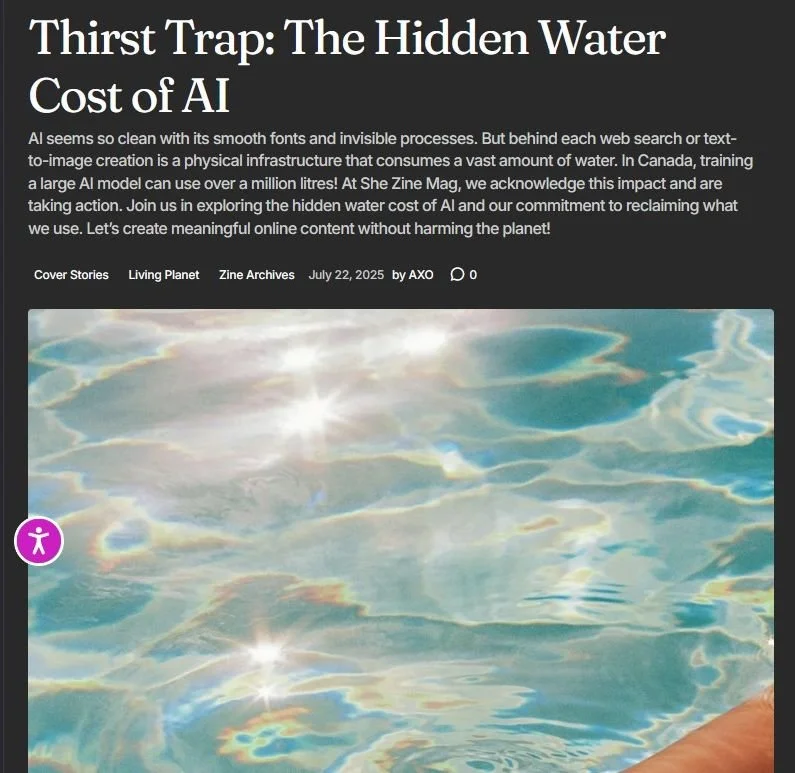
And finally, environmental impact, including our carbon footprint from shipping product to our estimated water usage tied to digital operations. We get into this more deeply in our article on the environmental toll of digital publishing, but the short version is: digital media isn’t immaterial. It uses water and energy, and we want to be transparent about that cost.
We talk a lot about ethics, but the internet itself isn't neutral. Every page load, every file stored, every tool we use draws water and energy through server farms. The dashboard lets us quantify that impact (as best we can) so our audience sees the real environmental cost of digital media.
It’s not about guilting our readers — it’s about holding ourselves accountable. It’s basically our way of saying: “If we claim to be ethical, here’s the proof — and here’s where we still need to do better.”
How is the contributor onboarding and contract process structured to uphold creative freedom and ensure you don't change people's voices while still maintaining editorial standards and quality?
Our contributor onboarding process is built to protect two things at the same time: the writer’s voice and the magazine’s standards. We treat those as parallel priorities, not competing ones.
When someone joins us, the first thing they receive isn’t a contract — it’s a values brief. It outlines our editorial commitments (anti-racism, anti-colonial practice, feminist framing, accessibility, harm-reduction, and transparency) along with the tone and boundaries of She Zine. It’s basically a mutual agreement that we’re entering into a shared space with shared ethics. Only after that do we get into logistics like contracts and timelines.
We never rewrite someone’s voice into our own. If something needs clarity, fact-checking, or structural tightening, we communicate that directly. Notes always come with context: why a suggestion is being made and how it supports the writer’s intentions. And contributors own their work. Full stop.
We also build in a final “voice check” before publishing. Contributors read the final layout and confirm that it still sounds like them — not like us. If something feels off, we adjust.
What are the biggest operational or financial hurdles you anticipate encountering as you move toward launching paid contributor programs and a digital subscriber community?
That’s a big one for any small publication, as I’m sure you can appreciate, but especially for one running as many moving parts as we are. The operational overhead alone can get intense: hosting, email platforms, project management, accessibility tools, file storage, analytics, and all the creative software that keeps the magazine, the shop, and the community spaces running. None of that is cheap, and not optional if we want to build something that actually functions at scale.
The biggest shift from She Zine 1.0 is that we’re starting with paid contributors. Back then, none of us were paying writers — partly because we couldn’t, and partly because we hadn’t yet learned how necessary it is. You simply cannot build an ethical publication on unpaid labour. So now we’re investing in the foundation first. It slows growth, absolutely, but it means the growth is real.
So the challenge becomes: how do we build a financial model that keeps contributors paid, keeps the lights on, and keeps the magazine accessible to the people who need it most? A paid community helps, affiliate partnerships (ethically vetted) help, merch helps — but the real work is weaving those together without compromising the values we built the magazine on.
It’s complex, but it’s also the only path forward. Investing now means stability later, and stability is what lets the work actually continue.
Since She Zine explicitly states it does not aim to be the biggest, how do you personally define success for the magazine—is it defined by engagement, contributor retention, or community impact, or something else entirely?
I definitely define success as community. If readers are engaging with what we publish, sharing it with friends, feeling moved or challenged or comforted by it, then that’s success to me. If contributors feel supported and represented, that’s success. If someone reads a post and thinks, “This makes me want to make something,” then I feel like we’ve been a success.
As the editor, what is the intended purpose of your own "Editor's Letter," and how do you hope it frames the rest of the magazine's content for the reader?
For me, the Editor’s Letter is the grounding force of the magazine. It’s the moment where I get to speak directly to the reader. Not as a brand, but as a human being trying to make sense of the same world they’re living in.
The purpose isn’t to recap what’s inside the issue; it’s to set the emotional temperature and the thematic direction. Each month has its own questions and its own creative energy, and the Editor’s Letter is where I name that and give readers a way into it. It’s my chance to say, “Here’s the lens we’re looking through this month, and here’s why it matters.”
If the letter can make someone feel seen, curious, energized, or simply more connected to what we’re exploring that month, then it’s done its job. It’s about opening a door and saying, “Here’s the theme, here’s the mood… come meet us in it.”
What has been the most personally rewarding story or submission that you have brought to publication in your time as editor?
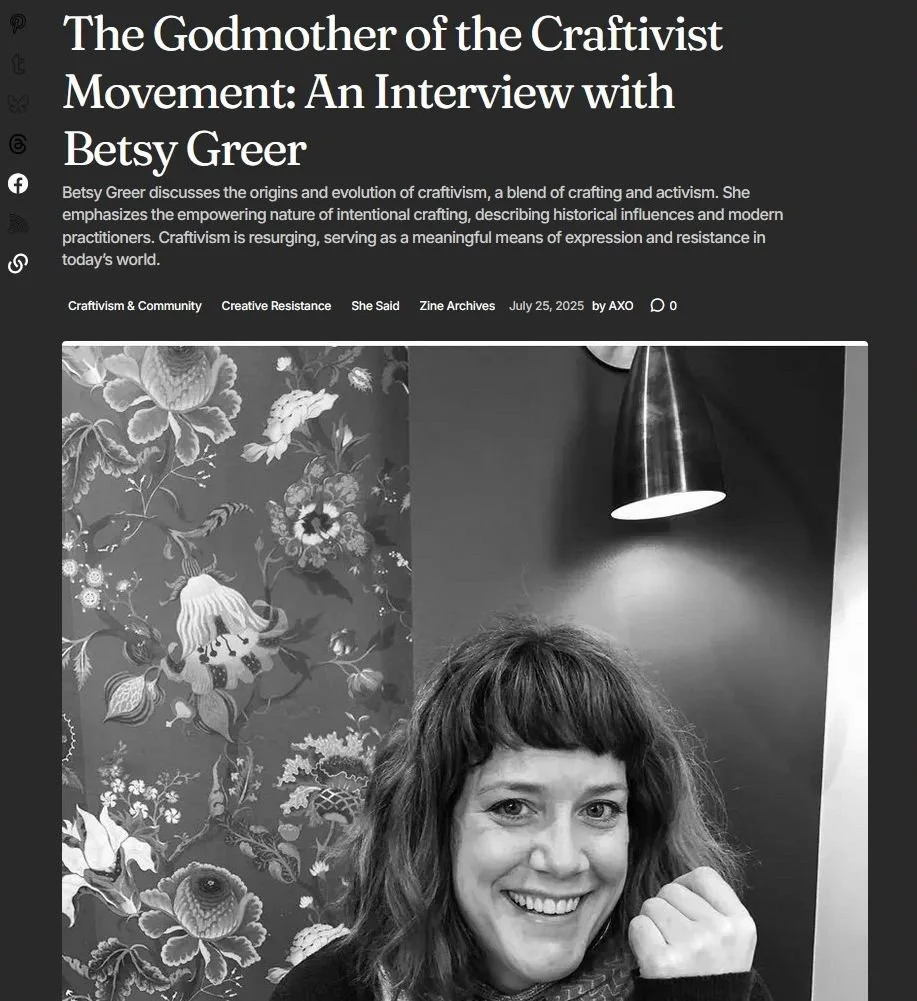
I did an interview in 2018 with Betsy Greer who is considered the godmother of Craftivism. She is credited with coining the term and is someone who I have been following since the early 2010s. To be able to have a conversation with her for She Zine was a huge full circle moment. I was definitely fan girling out when she agreed to talk to me. The interview turned out great and was a lot of fun. We republished it on She Zine 2.0 and you can find it here.
https://shezinemag.com/the-godmother-of-the-craftivist-movement-an-interview-with-betsy-g
For readers who are inspired by She Zine's ethos and want to start their own community-driven, ethically-minded creative project, what is the single most important piece of advice you would offer them?
If we’re inspiring readers to pursue their own creative projects, then we’ve already achieved our goal — but if I had to offer one piece of advice, it would be this: start small and stay accountable.
A community-driven, ethically minded project doesn’t grow because you have a perfect plan; it grows because you build one honest step at a time, with your values guiding every decision. You don’t need scale, a polished brand, or a full contributor team on day one. You need clarity, transparency, and a willingness to listen — especially when the feedback is uncomfortable.
If you can hold onto your ethics while you’re still tiny, you’ll know how to protect them when you’re bigger. Everything else is just details.
Any music you’re listening to these days that you’d like to share with us, Canadian or otherwise?
Absolutely! I have Dilly Dally and NoBro on heavy rotation currently. Both are female fronted acts from Toronto, so it hits all buttons for me. I’ve also been going down a ‘90s indie rabbit hole and have bands like Dinosaur Jr, Sebadoh, Hüsker Dü, and Fugazi on my go to playlist. I also recently rediscovered Mcllusky from Scotland via their live album “Mclucky Do Dallas”. They’re a ton of fun. ‘Alan is a Cowboy Killer’ and ‘She Will Only Bring You Happiness’ are probably my faves off that record.
Anyone you’d like to thank?
I always want to thank my sister, Lauren, who does a ton of quiet, behind-the-scenes work for She Zine. She keeps things moving, keeps me sane, and jumps in wherever she’s needed without ever asking for credit. And my partner John deserves a huge shoutout too —he’s the person who listens to every half-formed idea, fixes whatever breaks, and supports this whole project in ways most people will never see. They both make it possible for me to do this work.
Thanks to Allison for joining us, and go check out what they’re doing at https://www.shezinemag.com