

Standing Up: An Interview With Documentarian, Activist and Artist Abby Martin
By Staff | June 22, 2026
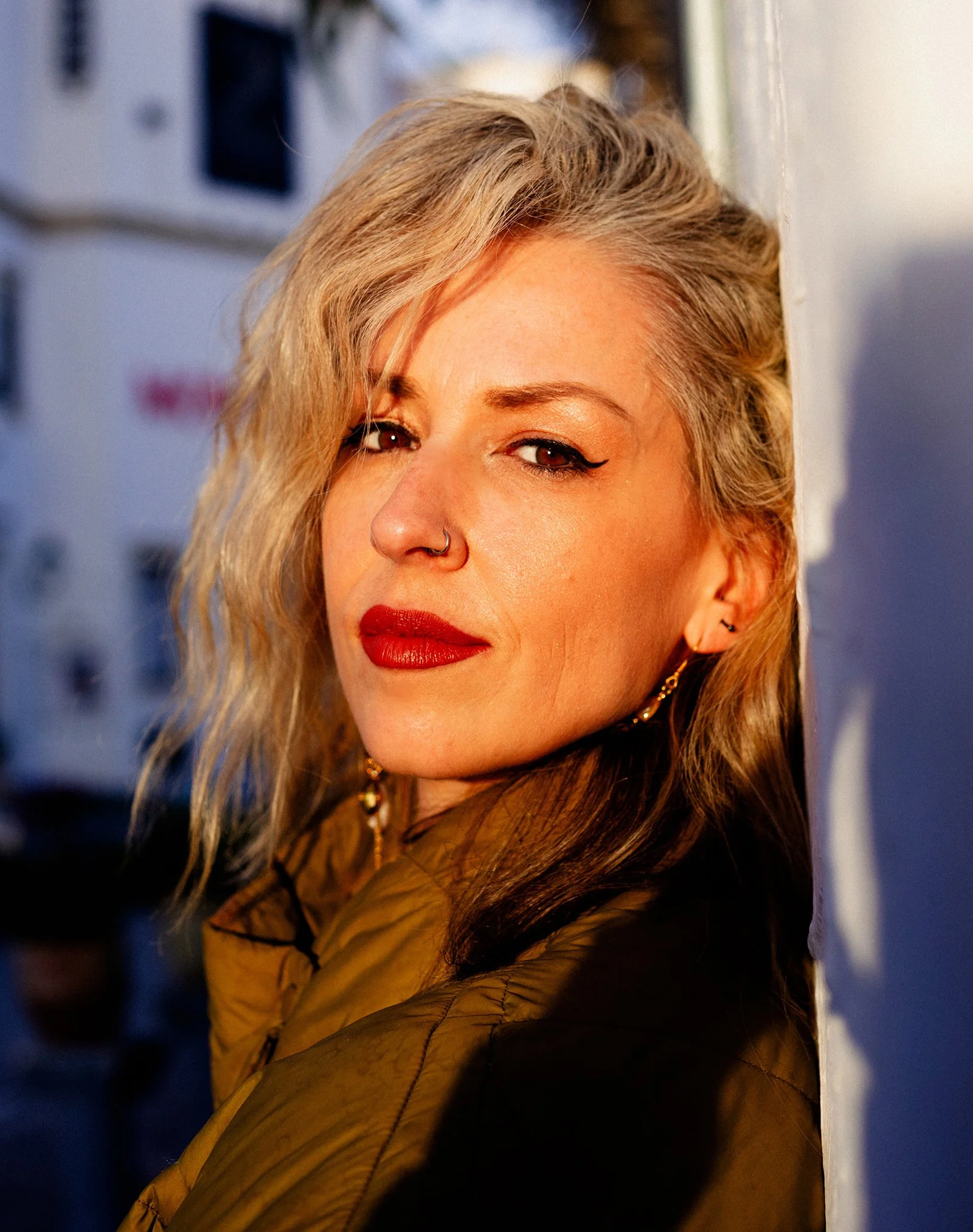
We interview punk bands, punk organizations, punk labels, other punk magazines - you get the idea. Yet every so often we wind up interviewing someone who fully embodies the punk ethos without ever tuning a bass or hauling an amp through the stage door of a dingy club in Brooklyn.
Suing the state of Georgia over forced anti-BDS pledges? Making a documentary about the brutality in Gaza - not in 2026, with increasing popular support, but seven years earlier? That’s punk.
This interview is thoughtful, opinionated, and scathing in it’s criticism. Many forms of journalism may have largely lost it’s teeth these days, but don’t tell Abby Martin that.
Welcome Abby! As a standard-bearer of advocacy journalism, how do you balance your personal activism with your reporting given the nearly complete polarization in current society?
I've always been rooted in movement building and advocacy journalism because I was an activist first, and I became a journalist out of necessity because of the failures of the corporate media during the leadup to the Iraq war. That's kind of what synthesized my understanding of media censorship, media consolidation, how the media was an arm and an extension of the government and was activated in times that we really needed media accountability just to be propagandists and stenographers for the US government.
There's this myth of the liberal media, and it's obviously false as we see the latest merger taking us from five corporations down to four with the Ellisons heavily involved in this, which are big Trump donors. So really, it's a right wing corporate consolidation of right wing billionaires and Trump loyalists, but it has kind of the auspices of liberalism because there's basically a framework in the narrow purview of corporate media that's right wing when it comes to Fox News, they say left wing when you're looking at CNN and New York Times. But I think we both know that that's a neoliberal corporate capitalist agenda that echoes the worst right wing propaganda that you see on Fox News when it comes to anything related to US foreign policy, and instead is somehow more destructive because it provides that veneer of liberalism and humanitarianism when it's justifying these horrific policies abroad.
So anyway, I've always been an advocacy journalist and been rooted in telling people stories and uplifting people's voices that are marginalized and oppressed by the very system that journalists should be reporting on, and in fact, they don't. Instead, they're toeing the status quo. They're basically apologizing for the system. And the truth is, they wouldn't ascend in the positions if they didn't do that. If they weren't loyal imperialists and capitalists and just kind of toed the line. And I think journalists try to do what they can within the parameters of what they're given and the narrow opportunities that exist in corporate media, which are rapidly shrinking today. I think the latest report is two weekly newspapers closing every single week, and that's just the state of media today. It's so much worse than it was 20 years ago when I got into this field.
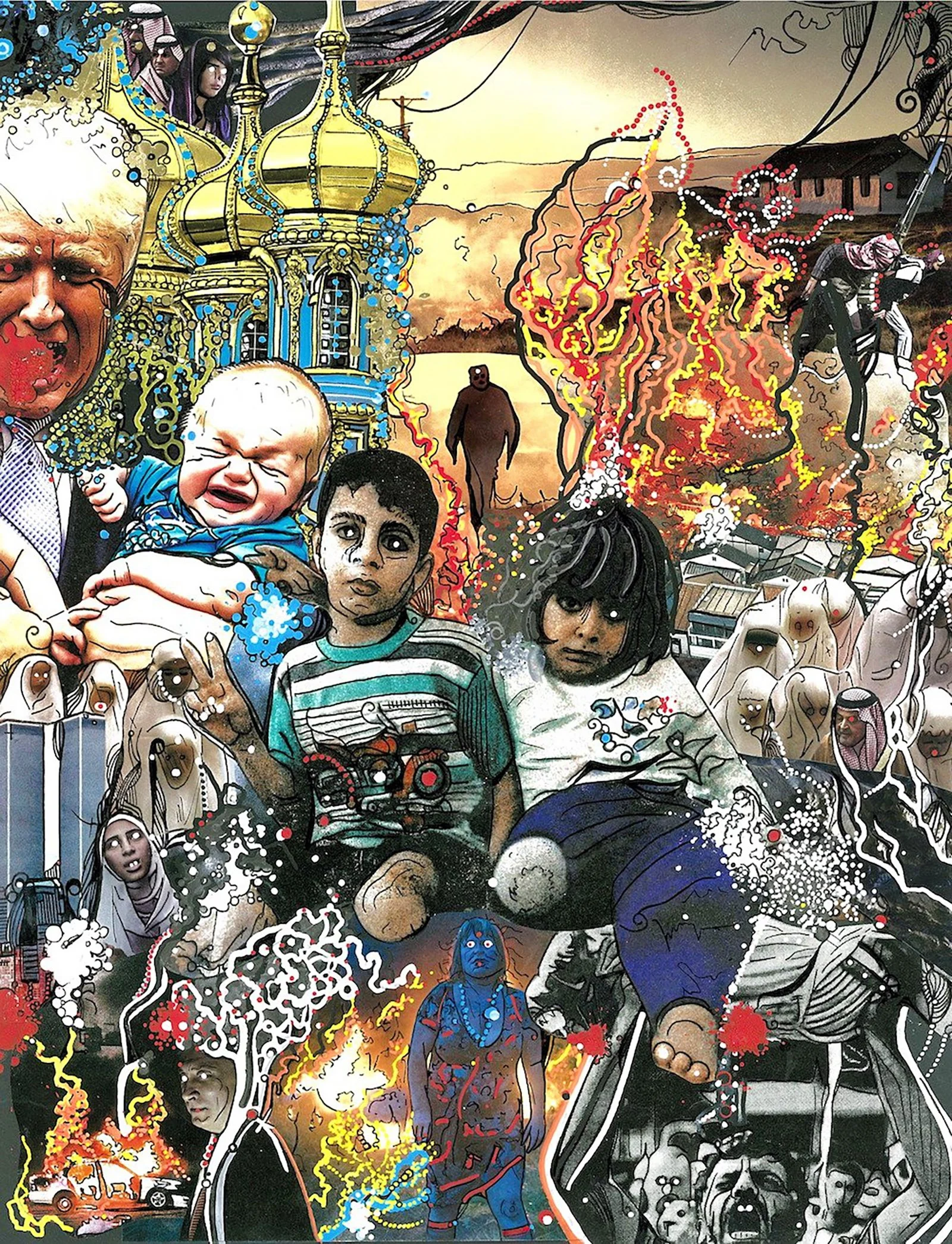
Mowing the Lawn, artwork by Abby Martin
Has your concept of the false left/right paradigm changed from your early days with Media Roots to your current work on The Empire Files?
I think definitely that that kind of tagline, outside of the left-right paradigm, we're mostly talking about the two-party system. So the left-right paradigm that's dictated to us, even though we know that the Democrats don't really represent left-wing views, that was kind of pushed on us as Democrats versus Republicans. So it was kind of tackling that as opposed to rejecting the notion that there is a binary. I don't think that it's false, that there's a right wing and left-wing perspective and analysis of our conditions.
So, yes, I do unapologetically have an anti-capitalist, anti-imperialist perspective in my reporting and framework and my analysis of all these issues, and that's how I report on these issues. I'm really clear about the bias, because I do think the notion of objectivity is fake. It's been kind of hammered into our heads to provide the cover of objectivity, but really every human being has extreme bias, and they just shroud and cover their objectivity with authority figures or think tanks and mostly these people are basically subsidized. If they're in the mainstream, they're subsidized by the same entities that we should be reporting critically on. So it's pretty frustrating, and it kind of feels like a lot of people are just circling the wagons and referencing corporate-backed sources and praise for each other at a time of genocide becoming the norm. And so I feel like my kind of journalism is refreshing for people, and I think it's really compelling, because I would rather know where someone's coming from, how they're funded, who they're speaking to, and for, instead of just having to guess who's funding these people. I mean, all of these weird pop-ups under the Trump administration, the Nick Shirleys - all these weird cutouts, it does feel like a conveyor belt of right-wing agitation propagandists, who are just somehow flooding and oversaturating the market.
In retrospect, how did the experience (and fallout) of your on-air condemnation of the Russian annexation of Crimea in 2014 shape your desire for editorial control in your subsequent projects?
The Crimea incursion was an interesting moment because I was very focused and centered on U.S. imperialism, obviously being an American there's only so much I can do. There was a reason that I took the job at RT - for one, why would I not? It's speaking to tens of millions of people around the world, given an international platform to tell truths that are simply not allowed on corporate media. But of course, when the Crimea thing happened, it just kind of activated this weird disturbing moment that felt like harkening back to the Iraq war propaganda where it just felt like RT became activated as a propaganda arm of Russia. So I went to my boss and asserted that I wanted to be free to tell the truth, tell what I thought about the situation. And so because I was elevated as this international hero in the corporate media and they tried to use me to toe this imperialist line against Russia, I just became acutely aware of how I was churned out through the 24-hour news cycle internationally - used, spit up; it was like this house of cards moment where you had Liz Wahl ushered in as like a Bill Kristol pawn to try to supersede what I did, override it and actually paint me as this lunatic. So it was such a fascinating moment. It not only made me just exposed to how the machinations of corporate media, the levels of propaganda, the levels that these people are willing to go to shape and control the narrative and to basically try to undermine networks like RT and crush them at any length. That was really startling.
But of course, after leaving RT, I knew that going to a place like Telesur I had to go and assert my editorial control, especially coming from RT. They were very clear about my position that nothing would have oversight. I would just do exactly what I wanted and that included being on the ground in Venezuela, being on the ground in Cuba, even though those were state funders of Telesur as part of the state conglomerates, I still went and asked very critical questions and framed it exactly the way that I wanted to and they knew that going in. And I think that in a way, I kept telling both of these networks, it's really important because it paves credibility when you have people that don't just toe the state line and are deemed state propagandists. You want people who can be critical, independent eyes and navigating these issues critically. And that's exactly what I did at Telesur and I think that's why eventually President Diaz-Canel gave me the first interview as an American journalist to sit down with him during this insane moment.
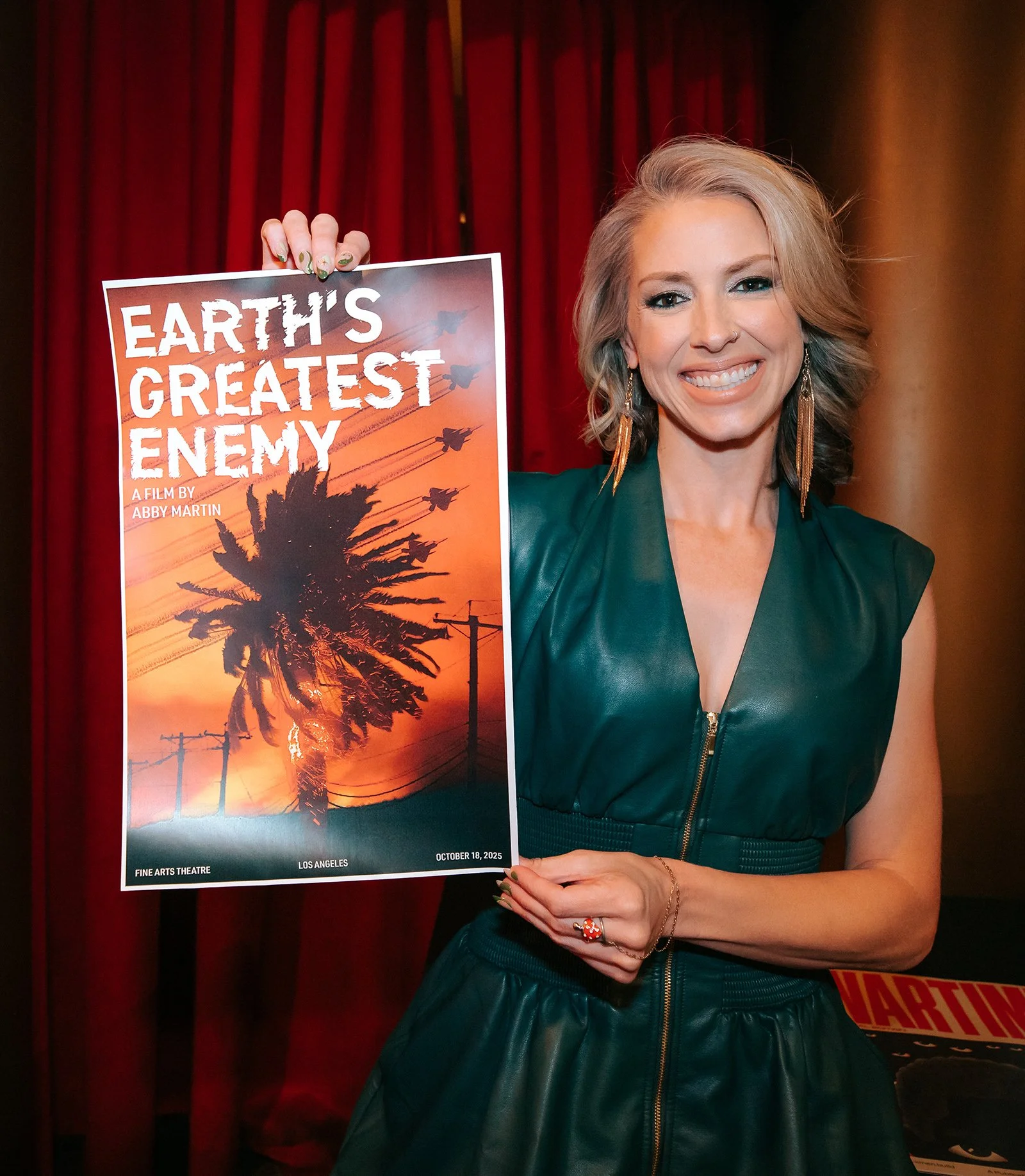
And that's why to this day I have to have a full editorial control over every single thing that I do. That's never been a question. If anyone ever wants to give me money, I've always had zero strings attached. There’s never any advice that I would take from anyone - everything's our own doing at Empire Files and Earth's Greatest Enemy was exactly the way that we wanted it to be done. That's why we didn't get the financing or the recognition that we deserved to at the film because it was exactly the way we wanted it to be done with no editorial control or oversight. That's exactly, as described in the film, why we couldn't get a military official to sit down with us because we didn't give up any control to the military.
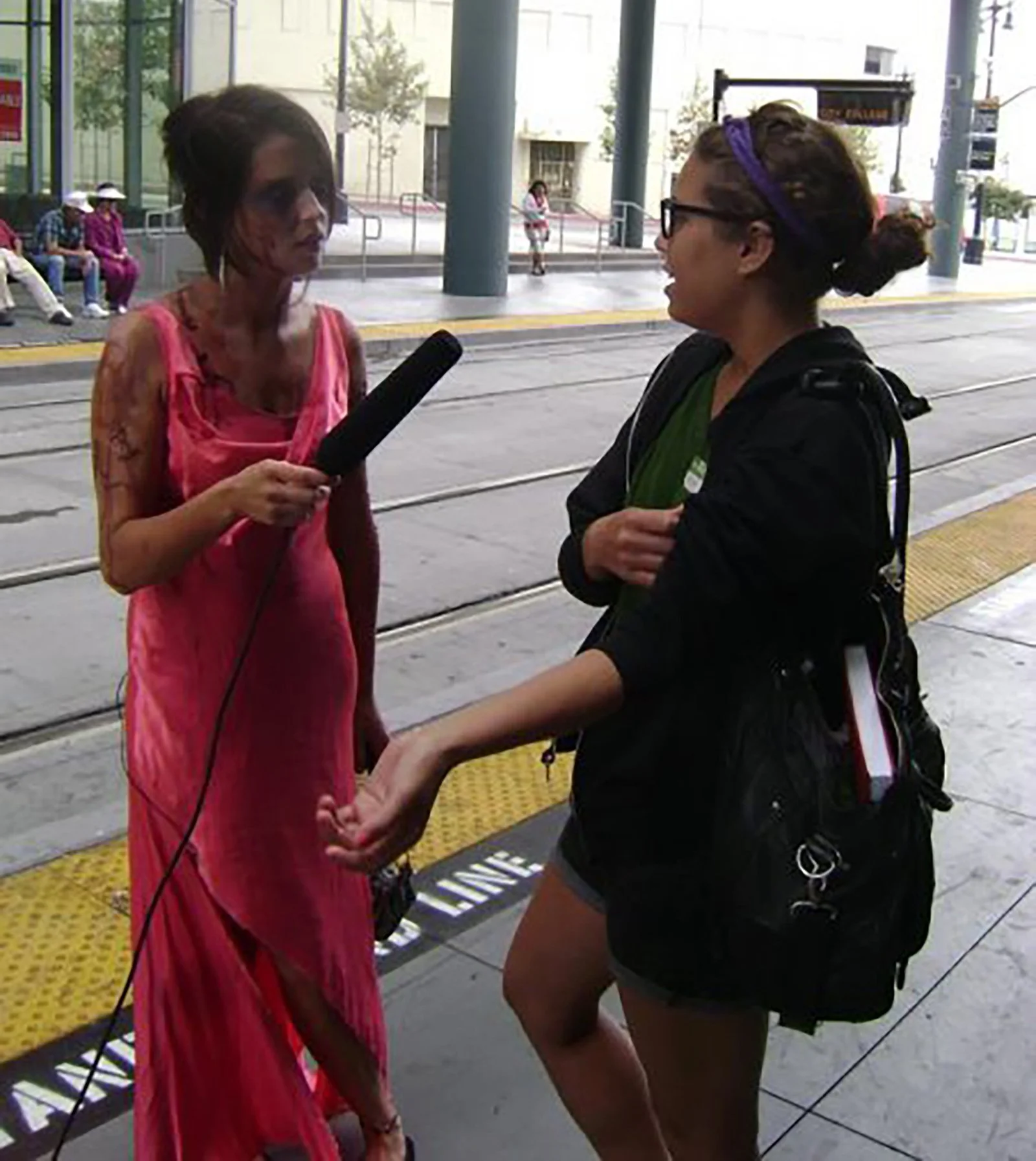
As a zombie at Comic Con
Gaza Fights For Freedom (2019) opened a lot of eyes to the brutality in Palestine, long before it was on many people's radar. What would you say were the biggest challenges you faced coordinating on-the-ground reporting during a violent occupation?
Gaza Fights for Freedom was filmed during the Great March of Return, so subsequently over the course of six months to a year during the height of those protests. I started coordinating when I was on the ground in 2016 in the West Bank, when I was banned from entry from Gaza by Netanyahu's spokesperson, the chief press officer, who basically called me a propagandist and an Iranian agent. I'd never heard that before - I was used to being called a Russian or a Venezuelan agent, so that was really bizarre. Needless to say, I still ended up connecting with colleagues through the blockade and working with them over the course of the next few years and I wanted to do an Empire Files series about the Great March of Return. But when I saw the incredible footage that I was helping direct and these interviews that I was directing, I saw just how brilliant the cinematographers were on the ground. Our friend, Maz Maza - six of his brothers were murdered during the course of this genocide, and he's still in Gaza today. He risked his life weekly getting this incredibly harrowing footage for the documentary. It was very difficult to receive and send the footage. It was very difficult to direct a movie from not being able to enter this territory. It's just horrific. And it was also, I think - just fast forward to today - the most horrific thing is the fact that they're still there.
I have the recognition for the movie, but they're the ones who deserve everything because they're the ones living the experience. They're the ones who risk their lives to get the evidence, and again, it's just absolutely traumatic to know that this is what Palestinians and Gaza are still going through to this day. Gaza Fights For Freedom was simply a warning, like a very foreboding ominous premonition of what was to come. And we all had to watch it come to fruition in the worst possible fucking way (editor’s note: credit to Moaz Mousa, videographer for the film).
Earth’s Greatest Enemy focuses on a subject that is barely covered in mainstream media - the environmental impact of the U.S. military. Why is the connection between militarism and climate change so often completely omitted from mainstream environmental discourse?
I think the impact of militarism on the environment is excluded from mainstream discussion because of just the way that militarism is embedded culturally and baked in the foundation of all the mythology of America. I mean, American exceptionalism - America has a bedrock of the pinnacle of freedom and human rights. I mean, all of these things, if we really nakedly looked at what America really represented, it's always been genocide, colonialism, and ecocide. Ecocide’s always been a facet of our unregulated fucking capitalistic expansion and imperialism. There's still dead zones from World War I, from small armaments. So because the military has been so rehabilitated, whitewashed especially after 9/11, there's been this reconcerted effort to try to rehabilitate the military and make it as this force of benevolence and good around the world. Obviously, Gaza shredded all of that and collapsed that entire framework, but I think it's been so difficult to unpack that. And I think neoliberalism, this capitalism with the pretense of human rights and democracy, this liberal idea of individual freedom and imposing our will on the rest of the world with this ordained right, with free markets as the fucking bedrock of this shit. Because of that, “Democrats and liberals”, who are just capitalists, have basically co-opted every single potentially revolutionary struggle - environmentalism, women's rights, Black liberation, all of these things and basically folded it into neoliberalism. And so for the past 40 years, it's like everything from labor to the environmental struggle have all been co-opted and defanged and basically built into a system that eventually oppresses us and what these fights were originally trying to battle, trying to rectify, trying to build accountability within. And so that's the unfortunate part.
I think right now we're looking at a unique moment where we can confront these institutions that are obviously just rankly hypocritical and shape something new. And so there is something beautiful about now that we cannot, there's no way to be hoodwinked by this shit anymore. It's too obvious now that we see Gaza, now that genocide has become the status quo. And yeah, the other component of this is just a lot of these NGOs - they exist and thrive within that kind of fucking swamp of D.C., they rely on the bureaucracy, they rely on government grants, they rely on access. And so, of course, they're not going to shake the very institution, the U.S. empire. This is what our economy is built on, the permanent war economy. It literally is like a for-profit corporation at this point. And so, you're not going to rattle that. It's easy to call out fossil fuel corporations, but it's not easy to call out the enforcement mechanism for them, the army that's being used to enforce the fossil fuel infrastructure.
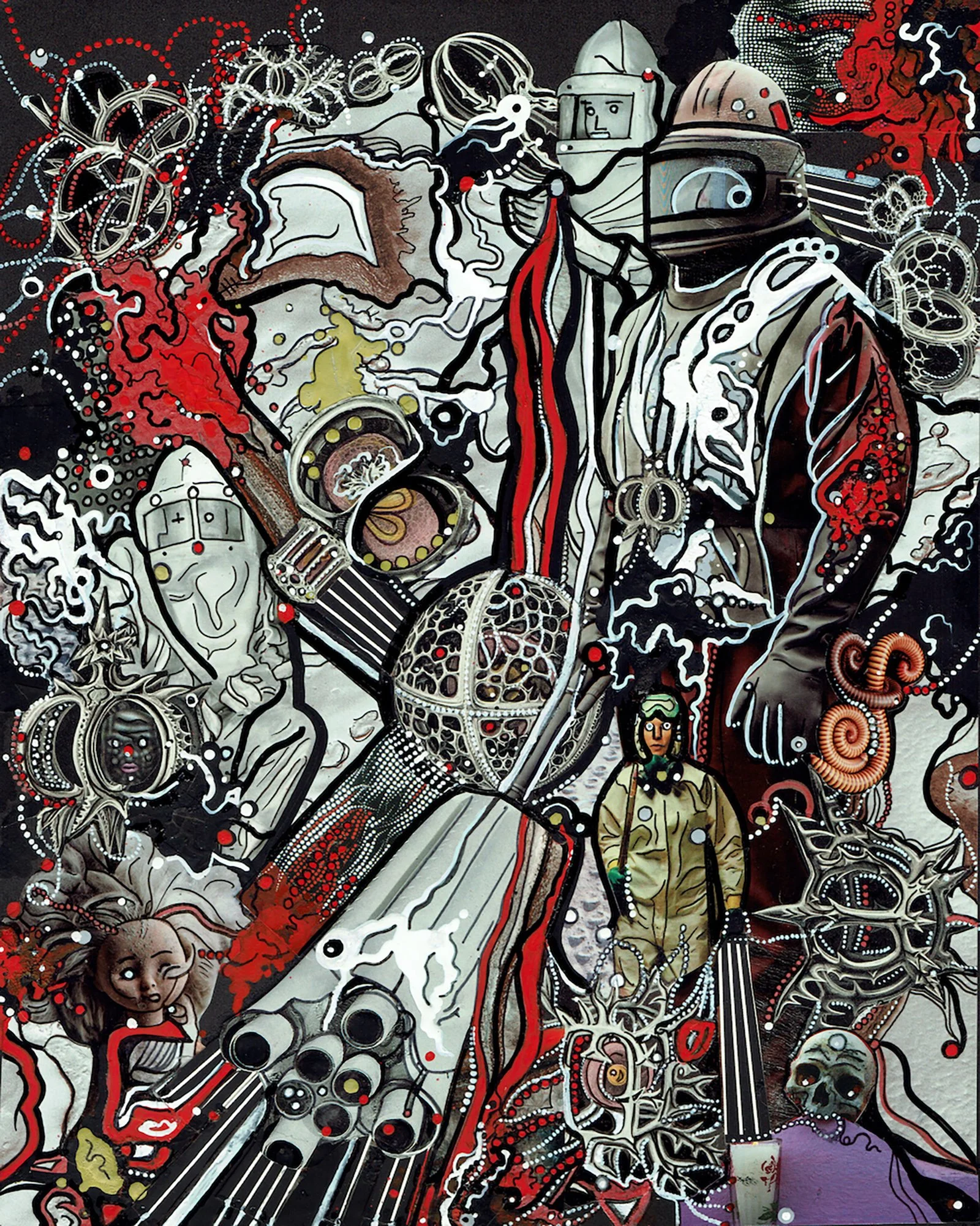
Coronavirus, artwork by Abby Martin
You successfully sued the State of Georgia over SB 327, a 2016 law requiring entities contracting with the state for $1,000 or more to certify that they are not participating in a boycott of Israel. What has that victory meant for the broader future of the First Amendment and the rights of independent journalists?
Bizarrely, I won on paper and won the foundational principle of the lawsuit, which is that you can't put a price on free speech - the right to boycott is enshrined in the First Amendment. During the Montgomery bus boycotts, this was part of our civil liberties enshrined by the Supreme Court themselves during civil rights. Now, oddly enough, an Israeli consulate official went to the State House in Georgia and basically lobbied for my lawsuit victory to be exempt because they wanted to up the cap from $1,000 to $100,000. So basically, the principle still stands. I still won on principle, but now it can only be a plot, like it's still on the books technically, not for people making $1,000, but if you make $100,000. So it was a way to make my lawsuit moot while still keeping the law on the books, but then upping the cap, if that makes sense. So I still won. It is confusing - I don't know if that's too fucking in the weeds, whatever, but anyway, it just shows you the lengths they're willing to go to not claim that I was victorious, even though Netanyahu himself responded to this. I mean, I think it shows you how successful you can be by taking on the system just one person. So many people are forced to sign these anti-BDS pledges every single day - everyone from construction workers to substitute teachers. It's not just political activists or speakers or documentarians like myself who are outspoken about this issue. It's literally everyone who's an independent contractor and more than half the states in the country. More plaintiffs need to take these on and we need to dismantle these laws. They are completely, flagrantly unconstitutional.
You are known for confrontational questioning of figures like Antony Blinken and Nancy Pelosi - how do you personally break through the scripted dialogue of corporate politicians to get a meaningful response?
You know, first of all, I think people always want to know how do I do it - how do I get in these spaces and confront these people? Even though I'm not granted official interviews with these people, it's not impossible to get in these spaces. It shows you how much access journalism is really the name of the game and how little people try to do the bare minimum of what journalism requires, which is confronting power, holding power to account quite simply.
The Antony Blinken thing and Nancy Pelosi, I think these are perfect examples of not only how scripted their responses are, but how revealing even within a scripted response those answers can be. Antony Blinken, even though the evidence was laid bare that Shireen Abu Akleh was murdered by an Israeli sniper, he continued to double down, and it just shows you just how staunchly they will continue to apologize for Israel, and even in the face of just the complete hypocrisy. I mean, he's there talking about human rights, and then in next breath, he's defending Israel after a sniper, like literally intentionally fucking murders a journalist. And of course, we see now just completely out the window over 200 journalists systematically executed by our greatest ally in the Middle East.
The Nancy Pelosi thing was revealing because in the answer, there's all this jargon about the military kind of being used as the solution, and that reveals a hell of a lot. It shows you that they've already ceded the inevitability that the military, even though it's been a main driver of climate change, they're going to point to it as the solution no matter what, because there's no creativity or ingenuity outside of what they have already deemed. Our fucking rulers, like this global military dictatorship, that's it. That's the end of history.
As a strong media voice for the Millennials, what advice would you have for young citizen journalists who want to cover stories that need public recognition without the backing of a major network?
My advice to young journalists: it's definitely a much tougher space than it was for me 20 years ago for many reasons. I mean, the oversaturation of media, the ability for anyone to weigh in how everyone and their fucking mother has a podcast, it's really hard to navigate the space, especially with the influx of AI and deep fakes and just how everyone feels like they have to chase the algorithm and over sensationalize each other to get the clicks and to get actual capital, which is really disturbing. I mean, look - I would recommend going if you can to avoid all of that shit, take your time, build up reporting in your community, building trust with the groups that you want to embed with to report on behalf of the stories that you want to tell. Don't just float in and out somewhere. Don't just live online trying to compete with people who are on social media - do long form investigative journalism. These opportunities still exist. There's tons of grants and organizations that are trying to build up avenues and opportunities for people who want to do just this. Look, I know it's not exciting and it doesn't have instant rewards and we're all kind of used to closing the circle for us, and I think we need to get out of that mindset because it's just not the way life works at all. And that's kind of why I decided to go the complete opposite and work five years on a project like Earth's Greatest Enemy because I didn't want to participate in the daily inundation of just the hellscape and the toxic kind of piling on of what felt like I was just adding to an echo chamber of my own thoughts and beliefs and it just felt like I needed to do something more beneficial. And I'm happy that Earth's Greatest Enemy exists to try to add to the tool in the arsenal to give us a fighting fucking chance against the parasitic billionaires that are robbing us blind and destroying the future of our planet.
With everything going on today - ICE, Gaza, Iran, Venezuela - it seems almost as if when there is news in one area, the others are pushed to the back burner if not ignored. Are there any issues that you feel personally passionate about that seem to you to be underreported or even completely ignored?
I agree that it does seem like when everything's focused on one issue, everything else is forgotten about, but I just think that's the way the media is generated. Everything's funneled, it's the one character a day syndrome, the one issue a day syndrome where everyone has to hit on the same thing, and it's kind of a bizarre circus. I think what Gaza has done, not only has it changed the world in nightmarish ways, and unpredictably savage and horrifying ways where we're now kind of in this permanent law of the jungle, but it's been this beautiful reckoning and reimagination of what's possible, kind of the burgeoning international solidarity that we can gain from each other and build upon, and the recognition that all of our struggles are interconnected. That's why I think people understand now that Gaza is everything, Gaza is why ICE is happening, Gaza is why Iran is happening, Gaza is why we can't afford bread, why gas is $6 a gallon, it's everything – the degradation of our environment, the clean water, the clean air, all of this is global, it's all going to be generationally felt, we're all products of the environment, we are all animals and creatures of the environment, and we are all connected.
And I think that our common shared humanity and empathy has been quite profound and beautiful, and for me, it continues to provide me revolutionary optimism in this moment and continues to make me double down on the work that I do, and the resilience to carry on, as long as our brothers and sisters in Gaza are having children and fighting with every fiber of their fucking being, how dare we not?