It’s Hard To Be A Saint: A Look Back With Cleveland’s Saints Of Lorain
By Staff | April 6, 2026
Out of pain and grief can often come some of the most important art.
Saints Of Lorain is a Cleveland-based ensemble rooted in the raw, unapologetic tradition of local punk, metal and rock ‘n’ roll. The band shares a deep, complex history with the band Al & The Coholics, and their work serves as a visceral narrative of survival and the emotional wreckage that follows loss. Through their music, specifically Before We Were Saints and Those Dark Roads, they explore a trajectory from the chaos of reckless youth to a dark, isolated confrontation with ghosts. This commitment to authenticity extends to their philosophy on music; by prioritizing physical media and intentional artwork, they push back against the disposable nature of streaming to provide listeners with a tangible connection to their stories. Ultimately, the band acts as a vessel for processing loss, moving through the pain of unsaid goodbyes toward a place of acknowledgement and endurance.
You’ve described Before We Were Saints as an exploration of your reckless youth, while Those Dark Roads is the descent and the argument with ghosts. Why was it necessary to sit in this darker space before moving toward the redemption you have planned for the next chapter?
Nick Pshock: You can't skip the breakdown. You can't go from reckless to redeemed without sitting in the wreckage first. Before We Were Saints was about the chaos; the drinking, the fights, the recklessness of youth. But when that lifestyle catches up with you, when people die, when you lose your brother; you don't just move on. You sit in it. You argue with it. Those Dark Roads is that argument. It's the unstable mind, the back-and-forth with ghosts, the isolation. Redemption doesn't mean anything if you didn't earn it by going through the worst of it first. We're not there yet. For now, we're taking people through this part of the journey.
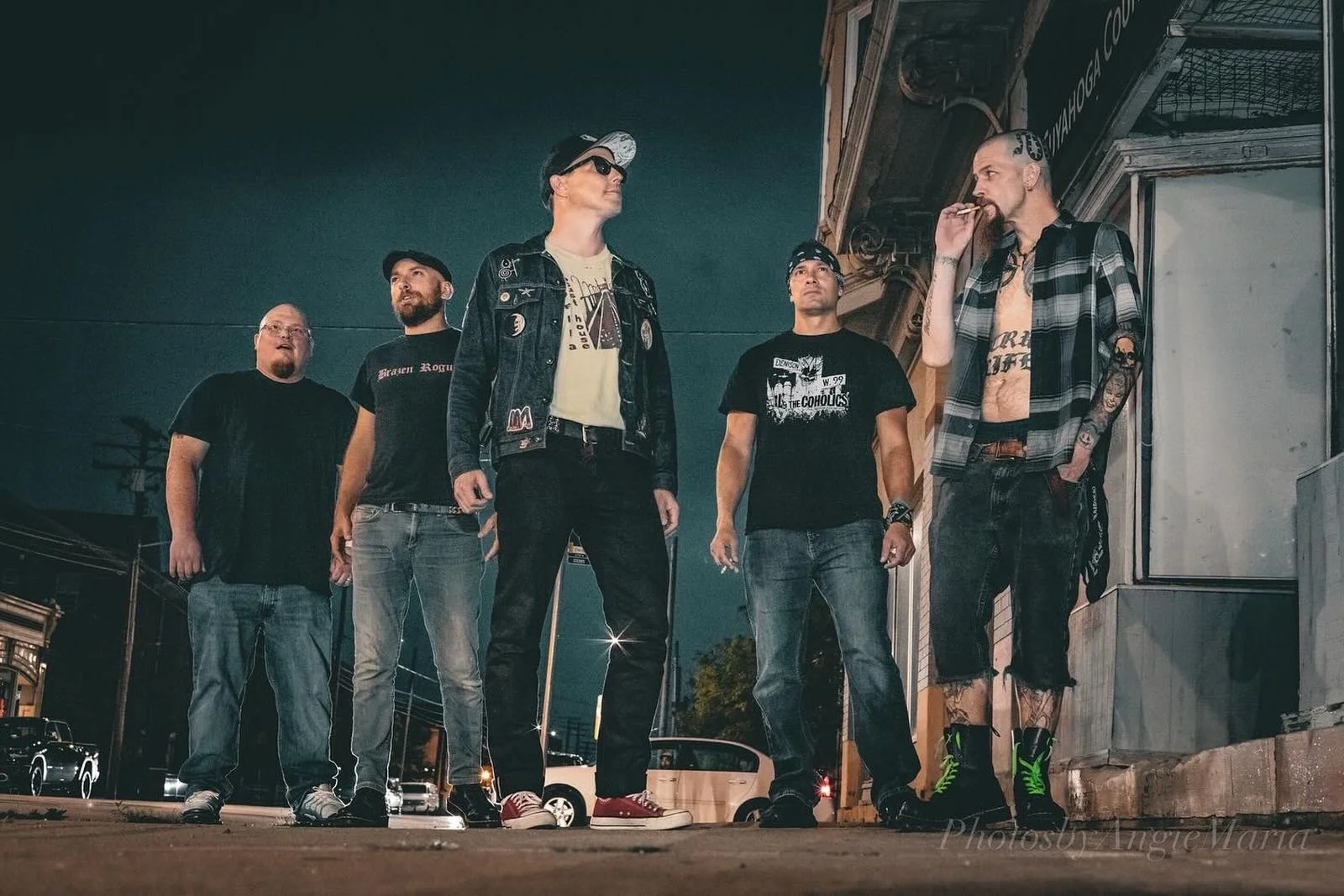
Photo credit: Angie Marie
For drummer Rob Young, this band is about a promise that the music would never die. How does the current Saints lineup (which is much of the original Coholics) balance the weight of that legacy with the need to create something entirely new?
We carry that legacy by revisiting the Coholics' songs and paying respect to those stories that brought us to where we are today, both personally and musically. John, my brother, always wanted me to be the next drummer for the Coholics. Before he passed away, he was having issues with his wrists and told me to replace him if it came down to it. I made a promise to him that I would and wouldn't let the music die.
When John passed away, it was devastating. Although it's painful to look back at a time when John was behind the kit, it's also healing for me to carry his spirit in those songs every time I play them.
With the future of the Saints' writing, we don't really weigh any past legacy onto the writing of new material. We just kind of write what comes up, you know, and if it's good, we keep it. Our songs are basically stories of real-life events, and songs like that really resonate with people. I believe that's why people enjoy our songs so much.
How did you approach the recording for the full-length, and what were you trying to capture? What did that process look like?
Attila Csapo, who runs “Lizard People”, recorded both “Before We Were Saints” and "Those Dark Roads". I wanted to follow up the EP in a way that showed the band's journey. We needed the sound to reflect that shift, not just lyrically, but sonically. It wasn't easy, and I'm sure Attila wanted to pull his hair out at times. But he did a great job of capturing what we wanted, which was for them to feel like they came from different eras. We were talking about the process and he said, “This was a progression and step forward from the first EP. It sounds more polished, paving the way for whatever's next.” That's exactly what we were going for.
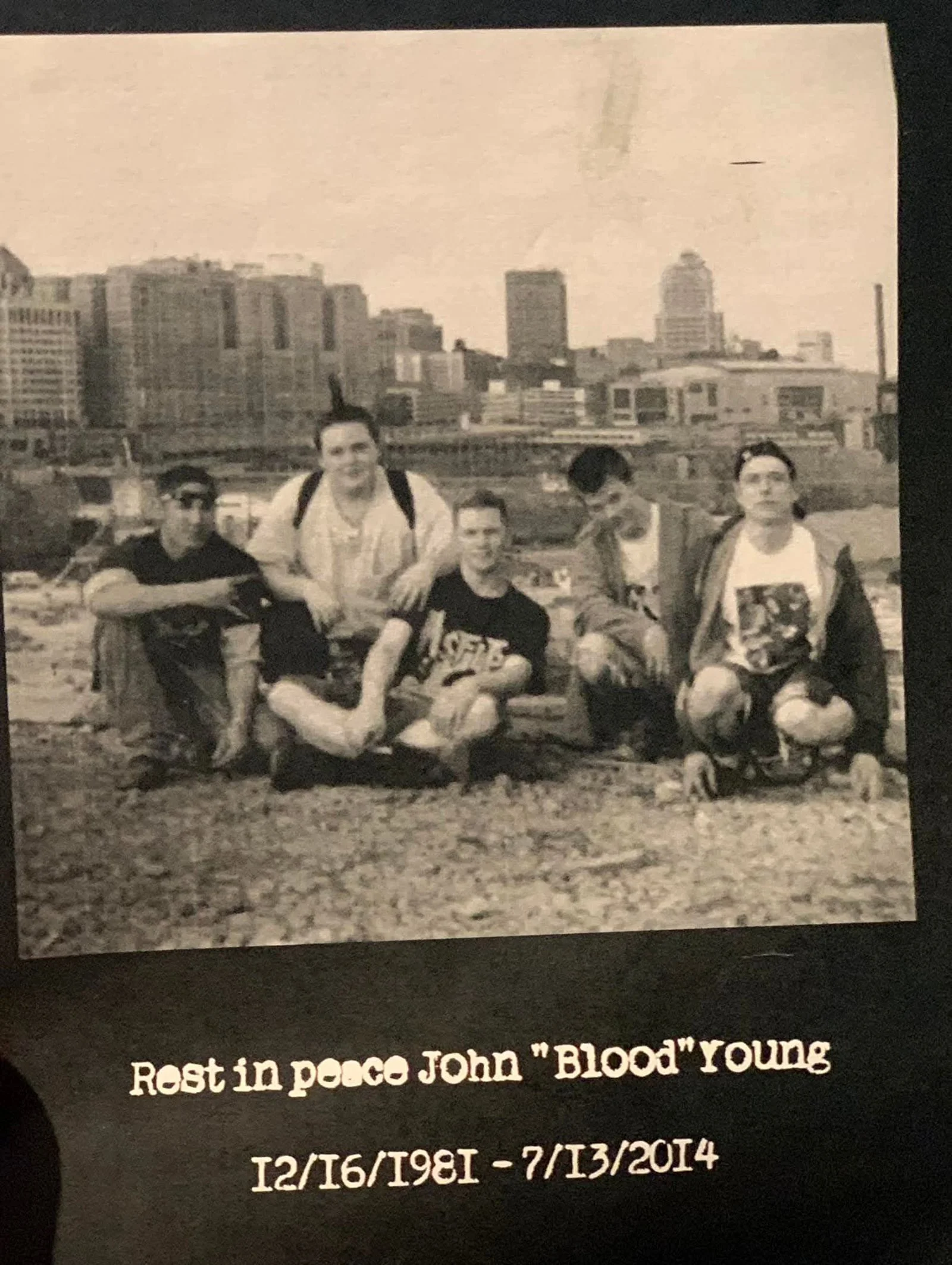
Part of the album is structured as a back-and-forth with Jonny Blood. How did it feel to step into a creative headspace where you were essentially writing a dialogue with someone you’ve lost?
I didn't write the lyrics. Al did. But when I was arranging the album and I started to see the pattern, the back-and-forth structure, I became emotionally invested in it. That's when I knew I was on the right track. Some songs felt like I was talking to Blood, telling him he's dwelling on his losses, that he needs to let go. Other songs felt like he was talking back, like he was the one falling apart. 'Our Last Goodbye' is the moment you realize the last time you saw someone was actually the last time, and you didn't know it.
Al sees things differently. In 'Falls Apart,' when he sings “I could taste the alcohol on your lips, you gave away all the trust we had left,” he's not talking about anyone else, he's talking about himself. That's the beauty of art. You can interpret it different ways.
That speaks to the power of Al's lyric ability. He can take you through that experience, what it feels like to argue with yourself, or leave you in a place where you talk to ghosts. It did that for me.
You’ve said that BillMike was the missing element of the Coholics. Why does having a fellow Coholic press the vinyl through Eleventh Hour Recording Company make the story feel like it’s finally come full circle?
BillMike and Blood were already playing music together when they asked me to join them at 15 to play bass. I said no. I tried guitar and I'm awful. They said forget that, the bass is awesome. Blood put on Rancid and I knew instantly what I wanted to be. BillMike showed me a simple walk and I stayed up for 13 hours playing 'Maxwell Murder' on repeat. In the morning, I could play it. It was like it was always meant to be. The three of us, that's where the Coholics began.
After Blood's death, there was a lot of back and forth about the direction of the band, and it usually ended with a standoff between me and BillMike. We almost did the band again, but we couldn't agree on the direction. I had a vision for telling the story. BillMike didn't want to go into the past. He said, “I'm sorry, but if you're gonna do this, you're gonna have to do it without me.” When the Saints lineup fell into place, I knew what I had. So, I pressed forward.
Fast forward to now and he offered to put out the record. I was not expecting that. The Saints took on the story of the Coholics. I didn't expect him to be part of something we fought about. But here we are. The fact that a Coholic is pressing Saints vinyl, it's family. That's what coming full circle looks like.
BillMike has also invested years in building Eleventh Hour Recording Company. He's gotten his process down, works closely with Cleveland legend Bill Fox, and really understands what it takes to bring a record to life. Down the line, I'd love to get in the studio with him. We know how to push each other. The friction is real, he'll want to go one direction, I'll want to go another, and neither of us backs down. But that's what makes it work. Getting all of us in a room with someone who understands the ins and outs of the band, and our individual strengths I think will help take us to another level. We're not there yet, but that's where we're headed.
You are offering a $20 package that includes an LP, a CD, a patch, and a sticker to ensure people own rather than rent your music from predatory streaming services. Why is the death of physical media such a personal grievance for you, and how does that influence the way you view those streaming services?
Because streaming services have turned music into a utility. You pay to access it, but you don't own anything. They can pull albums, change terms, delete your playlists, and you have no say if they do. Or they just fold and then what? We grew up holding records, reading liner notes, understanding the artwork. The music meant something because you had to invest in it. Now people pay $10 a month to rent their entire music library, and when the service shuts down or removes something, it's just gone. We wanted to push back against that. We're not faulting anyone for using it, but it will never replace that feeling. The $20 vinyl package, LP, CD, patch, sticker, is about giving people something they can hold onto. Physical media isn't dead, and we're happy to see it coming back.
Your opinion that music shouldn't just be background noise and that there is (and should be) intention behind every piece of the artwork and liner notes. Can you walk us through a specific visual element on Those Dark Roads that fans should look for to better understand the story?
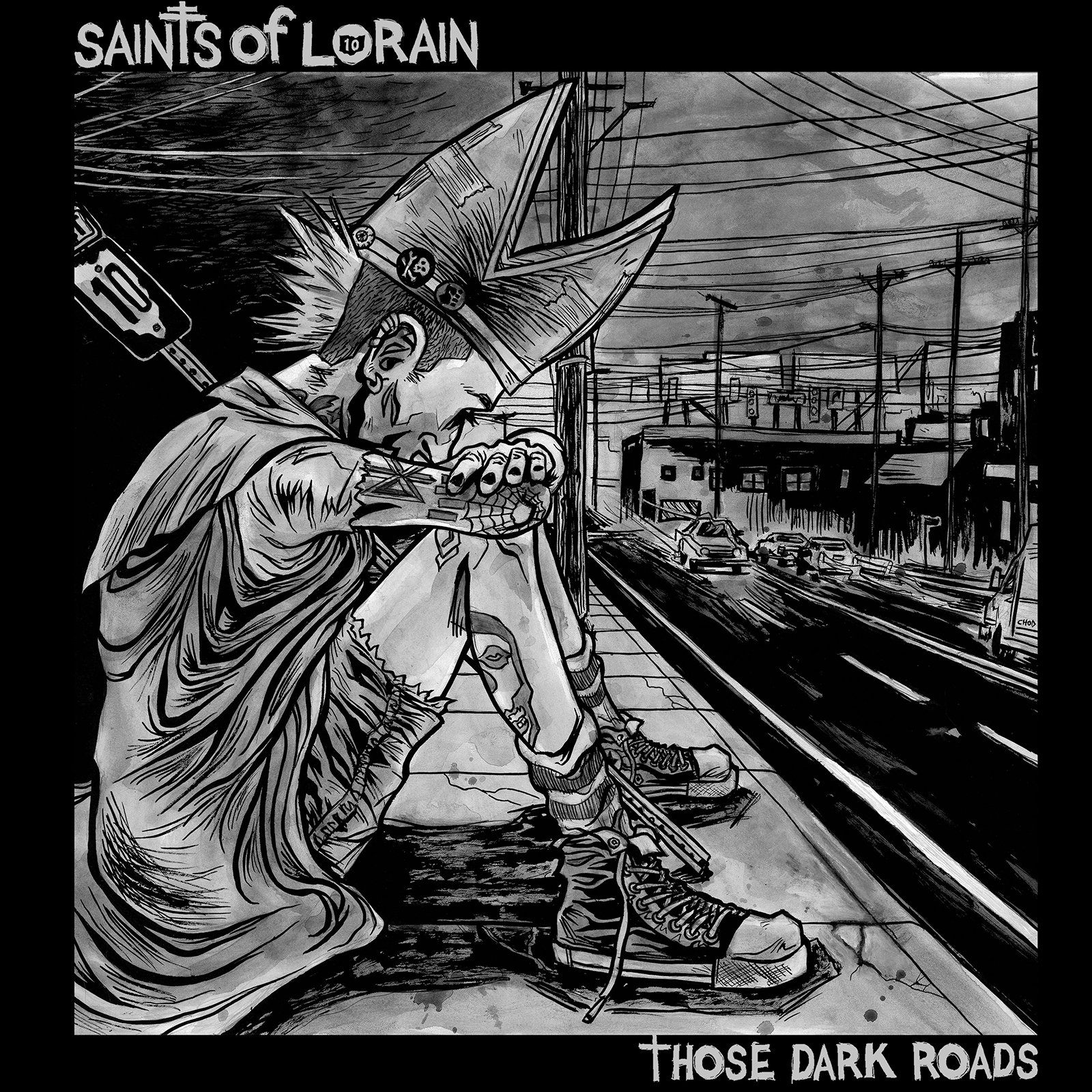
Artist Chad Kimes created the album cover, which shows a Saint sitting on the edge of Lorain Avenue in Cleveland, our main drag, head bowed across folded arms, absorbing the weight of loss. He's draped in tattered robes, legs stretched out, hunched over in grief. That posture says everything: he's exhausted, he's bearing witness, he's carrying what we can't hold ourselves.
The background is Cleveland: power lines, traffic, the grit of the streets where this story has always lived. The Saint is sitting in the middle of it all, taking it on.
I've thought about naming him, Witness, Record, but if he's part of all of us, part of everyone following this journey, then it's not really up to me to name him. I can only say what he means to me. He's whatever you need him to be in that moment. For me, he's the one absorbing the loss so we can eventually let it go.
Including Before We Were Saints in the vinyl package was intentional. It's part of the story. That album's cover shows the cost of survival: Rob at his brother's gravesite being comforted by the Saint. There's a lot of emotion that comes before you truly say goodbye to someone, and some people never do. That's Those Dark Roads. The two covers together tell the full story, the cost of survival and the descent that follows.
With over 25 years of Cleveland punk DNA in this band, how has the "Cleveland Sound" evolved for you, and where do you feel Those Dark Roads fit into that lineage?
Everyone thinks they're doing something unique. That's a stretch, a lot has already been done. But maybe the way you do it is what's special. We've always been ourselves. We like all types of music, and we bring that life perspective into our writing.
What makes Those Dark Roads is the unconscious thought behind it. I don't think it was ever realized when it was written. We didn't sit down and say, 'Hey, we're gonna write about this concept or that.' We had so many songs written, but when I took a step back and looked at it, I saw a pattern. It was a holy shit moment. From there it was pouring through the songs to create that narrative.
Yeah, you can read through the lyrics of these songs and go, 'They're talking exactly about some of these moments, the feelings towards those times,' and that's true. But the overall arc wasn't realized. It wasn't intentional. Like I said,I didn't write the lyrics, but a friend of mine, Nico Walker, said something about writing that I think applies here: 'Don't worry about the fidelity of the story, just write, put it together later.' I thought about that while arranging the album. BillMike actually had the suggestion to end Side A with 'Those Dark Roads.' It still fit the narrative, and it was actually the perfect ending before flipping the record.
Cleveland punk has always been raw and unapologetic. We're not trying to recreate what came before. We're just writing from where we are, pulling from street punk, metal, garage, rock 'n' roll, whatever serves the story. Those Dark Roads fits into that lineage because it's honest, it's unconscious, and it came together the way it needed to. That's the Cleveland sound to me: no bullshit, just the truth of where you are.
Photo credit: Jessica Mowrer
The album ends with "Our Last Goodbye." After the descent and the breakdown explored in this record, where does that final track leave the listener? Where do you want it to leave them?
It leaves you with the realization that you didn't get to say goodbye. 'Our Last Goodbye' is the moment you accept that some conversations are over, whether you're ready or not. It's not resolution. It's acknowledgment. Where does it leave the listener? Hopefully with the understanding that loss doesn't get easier, but you keep moving anyway.
If you were able to pass along a message to Jonny, maybe just a post-it note taped to a copy of the CD, what would you like to tell him?
Sometimes I wonder if I even have to. Sometimes I wonder if the Saint is Him.